zonoopt documentation
ZonoOpt
This C++ library provides classes and tailored optimization routines for zonotopes, constrained zonotopes, and hybrid zonotopes.


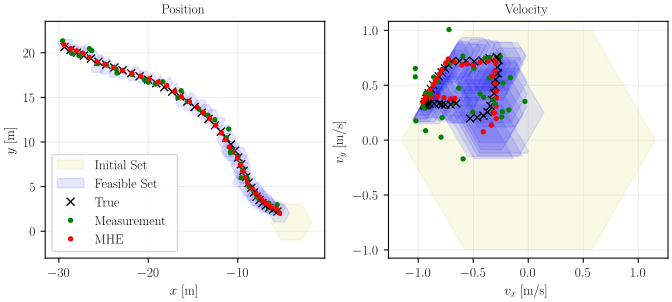
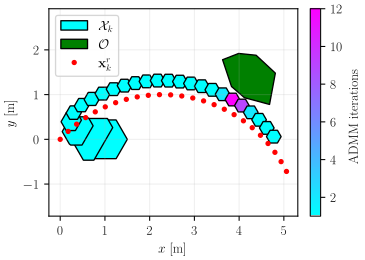
Zonotopes, Constrained Zonotopes, and Hybrid Zonotopes
Zonotopes and their generalizations are set representations widely used for reachability analysis. A major advantage of these set representations when compared to alternatives such as halfspace representation (H-rep) or vertex representation (V-rep) polytopes is that they have efficient identities for many important set operations. This makes them well-suited to contexts where efficient online set computations are required, such as online safety verification and set-valued state estimation.
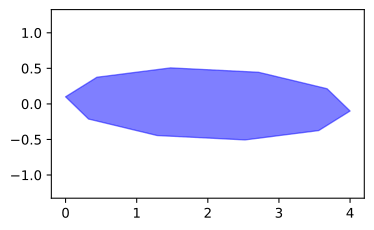
This library focuses specifically on zonotopes, constrained zonotopes, and hybrid zonotopes. A set $\mathcal{Z}$ is a zonotope if there exist a generator matrix $G$ and center vector $c$ such that
$$ \mathcal{Z} = \left\lbrace G \xi + c \; : \; \xi \in [-1, 1]^{nG} \right\rbrace \;. $$
Zonotopes represent centrally symmetric, convex polytopes.
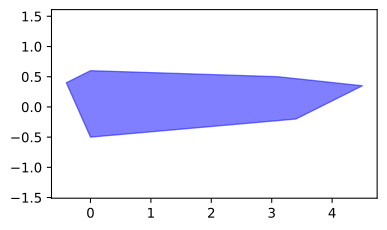
A set $\mathcal{Z}_C$ is a constrained zonotope if there additionally exist a constraint matrix $A$ and constraint vector $b$ such that
$$ \mathcal{Z}_C = \left\lbrace G \xi + c \; : \; \xi \in [-1, 1]^{nG}, A \xi = b \right\rbrace \;. $$
Constrained zonotopes represent convex polytopes.
Hybrid zonotopes extend constrained zonotopes by allowing for a subset of the factors $\xi$ to be binary-valued, i.e., $\xi = [\xi_c \quad \xi_b]^T$ where $\xi_c \in [-1, 1]^{nGc}$ and $\xi_b \in \lbrace -1, 1 \rbrace^{nGb}$. A set $\mathcal{Z}_H$ is then a hybrid zonotope if there exist generator matrices $G_c$ and $G_b$, center $c$, constraint matrices $A_c$ and $A_b$, and constraint vector $b$ such that
$$ \mathcal{Z}_H = \left\lbrace \begin{bmatrix} G_c & G_b \end{bmatrix} \begin{bmatrix} \xi_c \ \xi_b \end{bmatrix} + c \; : \; \begin{matrix} \xi_c \in [-1, 1]^{nGc},\; \xi_b \in \lbrace -1, 1 \rbrace^{nGb}, \ \begin{bmatrix} A_c & A_b \end{bmatrix} \begin{bmatrix} \xi_c \ \xi_b \end{bmatrix} = b \end{matrix} \right\rbrace \;. $$
Hybrid zonotopes represent unions of convex polytopes.
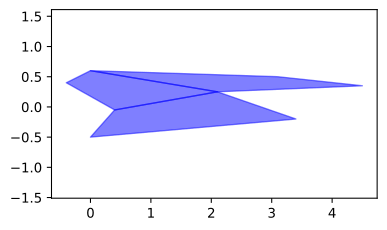
ZonoOpt Features
The ZonoOpt library provides classes and set operations for zonotopes, constrained zonotopes, and hybrid zonotopes. For cases where numerical optimization is required, e.g., checking if a set is empty or solving an MPC problem where the constraints are represented as a zonotopic set, custom optimization routines are utilized. Some key features of the ZonoOpt library are as follows:
All classes and methods are implemented using sparse linear algebra via the Eigen library.
ZonoOpt has minimal external dependencies, making it easy to integrate into robotics projects using C++ or Python.
Dependencies are Eigen, Boost, and nlohmann/json
Polymorphism is used to provide a common interface for zonotopes, constrained zonotopes, and hybrid zonotopes while allowing for specialized implementations.
E.g.,
supportis more efficient for zonotopes than for constrained zonotopes.
Factors are flexibly defined as either $[\xi_c \quad \xi_b]^T \in [0,1]^{nGc} \times \lbrace 0,1 \rbrace^{nGb}$ or the more standard form $[\xi_c \quad \xi_b]^T \in [-1,1]^{nGc} \times \lbrace -1,1 \rbrace^{nGb}$ to facilitate certain set operations.
Interval arithmetic is provided via the
Interval,Box, andIntervalMatrixclasses.Boost’s interval library is used within
Intervalfor most of the fundamental operations.
Operator overloading is implemented for commonly-used set operations.
Building and Installing
Python bindings can be installed from PyPI with pip install zonoopt. To build the bindings from source, use pip install .. Note that a C++ compiler is required to build from source.
This library can be used in CMake projects either via add_subdirectory or by installing the library.
When building the library for installation, you must set the option ZONOOPT_INSTALL to ON, i.e., cmake -DZONOOPT_INSTALL=ON -S . -B build.
Example CMake usage is as follows:
cmake_minimum_required(VERSION 3.15...3.27)
project(your_project)
add_executable(your_project
        your_project.cpp
)

# Using add_subdirectory
add_subdirectory(ZonoOpt)

# If installed, find the package instead
# find_package(ZonoOpt REQUIRED)

target_link_libraries(your_project PRIVATE ZonoOpt)
Examples
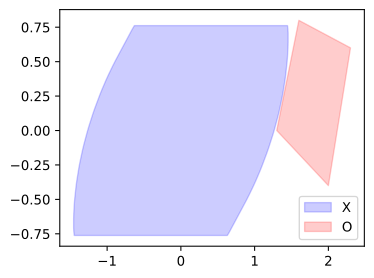
Consider the case that we wish to compute the robust forward reachable set of a discrete time double integrator system and verify that it does not intersect an unsafe set. We may do this in Python using operator overloading as follows:
import zonoopt as zono
import numpy as np
import matplotlib.pyplot as plt

# System dynamics
dt = 0.1
A = np.array([[1., dt],
              [0., 1.]])
B = np.array([[0.5*dt**2],
              [dt]])

# Initial set: box [-1.0, 1.0] x [-0.1, 0.1]
X0 = zono.interval_2_zono(zono.Box([-1., -0.1], [1., 0.1]))

# Input set: box [-0.2, 0.2]
U = zono.interval_2_zono(zono.Box([-0.2], [0.2]))

# Disturbance set: affine map of octagon
W = np.diag([0.01, 0.05]) @ zono.make_regular_zono_2D(radius=1., n_sides=8)

# Compute reachable set over 10 time steps
X = X0
for k in range(10):
    X = A @ X + B @ U + W

# Unsafe set
O = zono.vrep_2_conzono(np.array([[1.3, 0.],
                                  [1.6, 0.8],
                                  [2.0, -0.4],
                                  [2.3, 0.6]]))

# Check for intersection with unsafe set
print(f'10-step reachable set intersects unsafe set: {not (X & O).is_empty()}')

# Plot the final reachable set
fig, ax = plt.subplots(figsize=(4, 3), layout='tight')
h = []
h.append(zono.plot(X, ax=ax, color='b', alpha=0.2)[0])
h.append(zono.plot(O, ax=ax, color='r', alpha=0.2)[0])
ax.legend(h, ['X', 'O'])
plt.show()
Equivalently, these calculations can be performed in C++ as follows:
#include "ZonoOpt.hpp"
#include "Eigen/Dense"
#include "Eigen/Sparse"
#include <iostream>

int main()
{
    // System dynamics
    double dt = 0.1;
    Eigen::Matrix<double, 2, 2> A;
    A << 1, dt,
         0, 1;
    Eigen::Matrix<double, 2, 1> B;
    B << 0.5*dt*dt,
         dt;

    // Initial set: box [-1.0, 1.0] x [-0.1, 0.1]
    Eigen::Vector2d x0_min, x0_max;
    x0_min << -1.0, -0.1;
    x0_max <<  1.0,  0.1;
    ZonoOpt::ZonoPtr X0 = ZonoOpt::interval_2_zono(ZonoOpt::Box(x0_min, x0_max));

    // Input set: box [-0.2, 0.2]
    Eigen::Vector<double, 1> u_min, u_max;
    u_min << -0.2;
    u_max <<  0.2;
    ZonoOpt::ZonoPtr U = ZonoOpt::interval_2_zono(ZonoOpt::Box(u_min, u_max));

    // Disturbance set: affine map of octagon
    ZonoOpt::ZonoPtr W = ZonoOpt::make_regular_zono_2D(1.0, 8);
    Eigen::SparseMatrix<double> W_map(2, 2);
    W_map.insert(0, 0) = 0.01;
    W_map.insert(1, 1) = 0.05;
    W = ZonoOpt::affine_map(*W, W_map);

    // Compute reachable set over 10 time steps
    ZonoOpt::ZonoPtr X = std::move(X0);
    for (int k=0; k<10; ++k)
    {
        X = ZonoOpt::affine_map(*X, A.sparseView());
        X = ZonoOpt::minkowski_sum(*X, *ZonoOpt::affine_map(*U, B.sparseView()));
        X = ZonoOpt::minkowski_sum(*X, *W);
    }

    // Unsafe set
    Eigen::Matrix<double, 4, 2> verts;
    verts << 1.3, 0.0,
             1.6, 0.8,
             2.0, -0.4,
             2.3, 0.6;
    ZonoOpt::ZonoPtr O = ZonoOpt::vrep_2_conzono(verts);

    // Check for intersection with unsafe set
    std::cout << "10-step reachable set intersects unsafe set: "
              << (!ZonoOpt::intersection(*X, *O)->is_empty() ? "true" : "false") << std::endl;

    return 0;
}
Further Python examples are located in /examples.
External Solvers
ZonoOpt supports Gurobi and SCIP as external solvers via dynamic loading. Please note that a supported version of Gurobi or SCIP must be installed on your system for dynamic loading to succeed. To invoke an external solver, pass a corresponding settings structure to the function requiring optimization. For example, a point projection using Gurobi in Python would look like:
settings = zono.GurobiSettings()
p_proj = Z.project_point(p, settings=settings)
Equivalently, in C++:
ZonoOpt::GurobiSettings settings;
auto p_proj = Z.project_point(p, settings);
To change the default solver, globally modify the default solver settings, e.g.,
zono.set_default_solver_settings(zono.SCIPSettings())
in Python, or
ZonoOpt::set_default_solver_settings(ZonoOpt::SCIPSettings());
in C++.
Documentation
Auto-generated API documentation is available below.
References
More information about ZonoOpt can be found in the following publications. Please cite one or both of these as appropriate if you use ZonoOpt in your published work:
J. A. Robbins, J. A. Siefert and H. C. Pangborn, “Sparsity-Promoting Reachability Analysis and Optimization of Constrained Zonotopes,” in IEEE Transactions on Control Systems Technology, doi: 10.1109/TCST.2026.3700277.
Robbins, J.A., Thompson, A.F., Glunt, J.J., and Pangborn, H.C., “Hybrid System Planning using a Mixed-Integer ADMM Heuristic and Hybrid Zonotopes”, 2026. https://arxiv.org/abs/2602.17574
Additional Notes
For internal reasons, ZonoOpt’s versioning begins at 2.0.0. Please note that the library is currently in Beta. In this phase, there may be API changes in minor version updates (e.g., 2.1.0 to 2.2.0). There will be no API changes between patch numbers (e.g., 2.2.0 to 2.2.1).
For Python users, ZonoOpt’s use of multithreading for some hybrid zonotope operations can cause issues with cProfile. Profiling with py-spy is recommended.
See Also
Projects Using ZonoOpt
pyspect is a Python toolbox for compiling temporal logic specifications into reachability programs.
Contents:
- ZonoOpt Module
BoxConZonoEmptySetExternalSolverResultsGurobiSettingsGurobiSolverResultsHybZonoIntervalIntervalMatrixItemsViewKeysViewOptSettingsOptSolutionPointSCIPSettingsSCIPSolverResultsSolverSettingsValuesViewWarmStartParamsZonoaffine_inclusion()affine_map()cartesian_product()constrain()convex_hull()from_json()get_default_solver_settings()get_vertices()halfspace_intersection()intersection()intersection_over_dims()interval_2_zono()make_regular_zono_2D()minkowski_sum()plot()pontry_diff()project_onto_dims()set_default_solver_settings()set_diff()to_json()union_of_many()vrep_2_conzono()vrep_2_hybzono()zono_union_2_hybzono()